[Timber]
Jarrah Wood: A Furniture Maker's Guide to WA's Hardwood
Jarrah is a dense, dark red hardwood from south-west Western Australia: hard, termite-resistant, slow to grow, and it darkens as it ages.
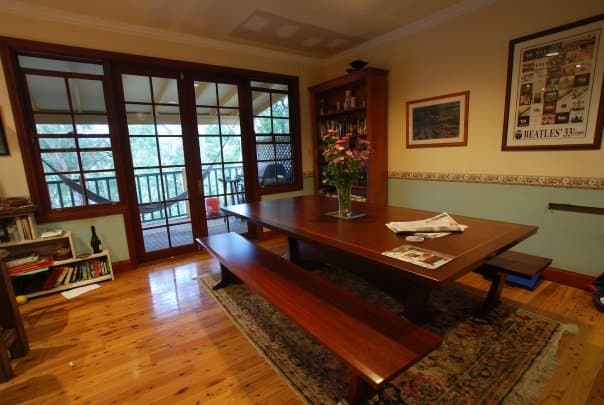
Jarrah is Eucalyptus marginata, a eucalypt that grows naturally in the south-west corner of Western Australia and nowhere else. Its timber is a dense, hard, red-brown hardwood that resists rot and termites and darkens with age, which is why it has gone into wharves, floors and fine furniture for well over a century.
I'm a furniture maker, not a forester, so this guide pairs the published facts with what the timber does at the bench. The figures come from government and industry sources, and where those sources disagree I give a range.
What is jarrah wood?
Jarrah timber comes from the heartwood of the jarrah tree. Heartwood is the dark inner core, and it runs from deep red and brown to burgundy. The sapwood around it is pale, from yellow to pinkish orange. The grain is moderately coarse and even, and now and then it runs wavy or interlocked, which gives the rippled figure called fiddleback.
Everything about jarrah follows from density. It is heavy, hard on tools, slow to burn, slow to rot and hard-wearing. It is also a large part of why it costs what it does.
The jarrah tree and the jarrah forest
The jarrah tree is slow-growing and deep-rooted. Mature trees stand roughly 15 to 40 metres tall, depending on the site, with trunks 40 to 100 centimetres across at chest height. The largest can reach about 2 metres in diameter. They are not especially long-lived. The oldest jarrah measured by ring count was 377 years old, and few live past 250.
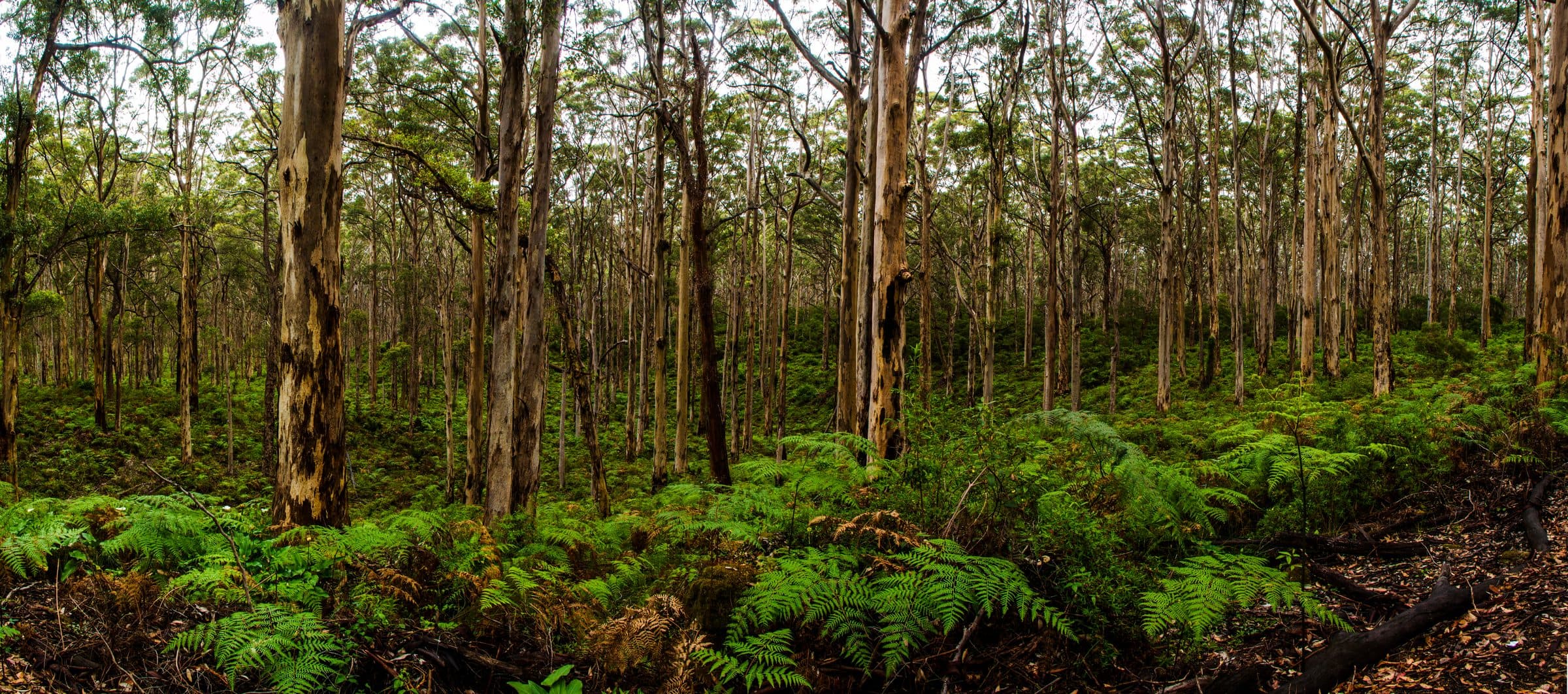
The jarrah forest sits east of the Darling Scarp, where annual rainfall is above about 600 millimetres. It runs from the ranges near Perth south to Albany, with outliers further north and inland, including a mallee form near Mount Lesueur. Forest height and productivity drop away from about the 800 millimetre rainfall line. Jarrah grows alongside marri nearly everywhere, and with wandoo on the drier eastern edge and karri in the cooler south.
The Department of Biodiversity, Conservation and Attractions (DBCA) estimates the jarrah forest covered about 2.8 million hectares at the time of European settlement, with around 65 per cent of it remaining. That figure comes from a 2015 reference built on 1990s data, so treat it as an estimate.
Fire. This is fire country. Lightning is a common source of ignition, and jarrah is built for it. Seedlings grow a lignotuber, a woody swelling at the base of the stem that stores buds and lets the tree resprout after fire or damage. Saplings burn easily until they are about 5 to 6 metres tall. After that the bark is thick enough to survive a mild fire, and scorched trees can regrow from buds on the trunk and crown. A very hot fire still kills many large trees.
Dieback. The biggest health problem in the forest is jarrah dieback, caused by an introduced soil pathogen, Phytophthora cinnamomi. It was first noticed in the jarrah forest in the 1920s and identified in the mid-1960s. It spread fastest when infected soil and gravel were moved around on machinery and roads. DBCA says more than 40 per cent of native plant species in the south-west are susceptible, including many in the banksia, grass-tree and eucalypt families. Jarrah is susceptible too. Marri and blackbutt are resistant. An older DBCA estimate put about 15 per cent of the jarrah forest available for timber harvesting as infested, and more recent DBCA work suggests the spread has slowed in the drier northern and eastern forest.
Logging and protection today. Western Australia stopped logging old-growth forest in 2001, when the state government set aside about 230,000 hectares of it for protection. Commercial logging of all native forest then ended on 31 December 2023 under the Forest Management Plan 2024 to 2033, which the government says protects nearly two million hectares of karri, jarrah and wandoo forest. Timber can now be taken from native forest only for ecological thinning and from approved mine sites. That change matters for anyone buying jarrah, and I come back to it under price.
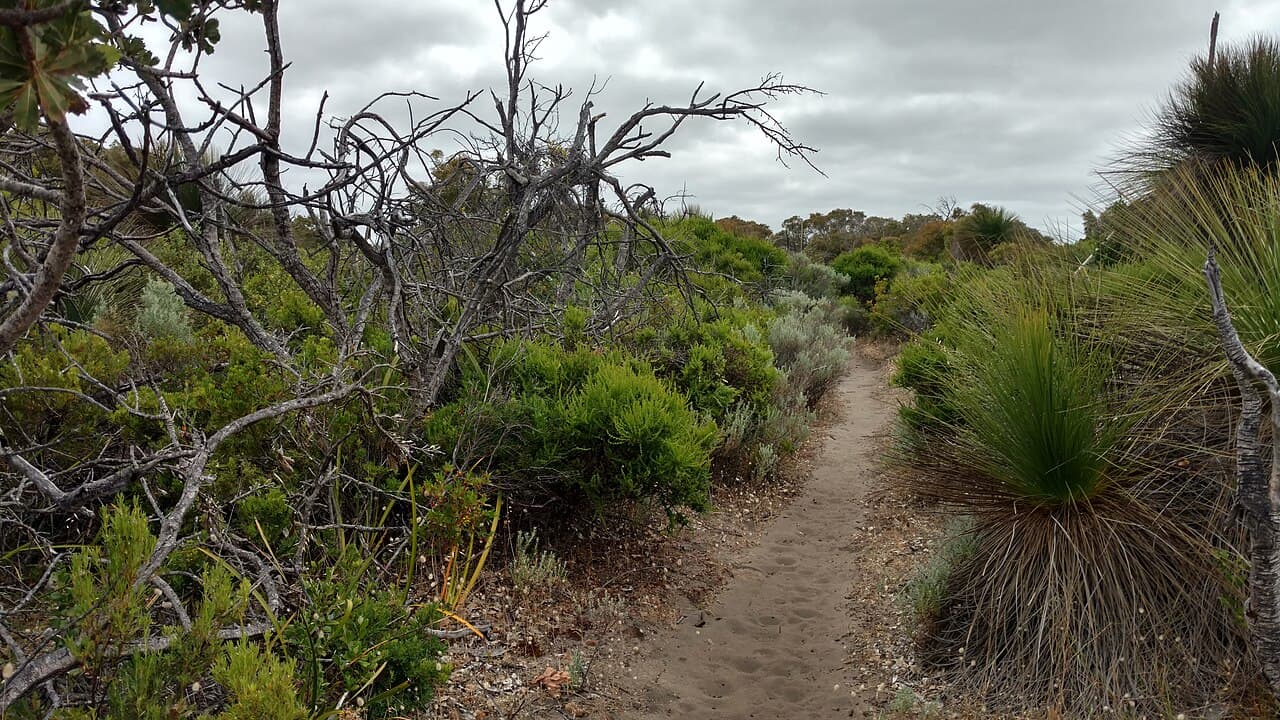
Photo: Lasthib, CC BY-SA 4.0 · via Wikimedia Commons
What colour is jarrah?
Jarrah is a deep red-brown. Fresh cut it can look pink or bright red, and the heartwood runs from light pink-red to something close to chocolate with a purple tinge. The sapwood is pale yellow to pink-orange, and in furniture we usually cut it out.
It darkens. The Queensland Government notes that jarrah heartwood usually deepens with exposure, and it does so for decades. Over thirty or forty years a table moves from red-brown toward a warm chestnut, and the grain becomes clearer rather than fading. Sun speeds it up, and a piece in a bright room changes faster than one in a hallway. Recycled jarrah from old buildings is often nearly black on the surface until it is planed back, and underneath it is a vivid red. The care guide has a year-by-year breakdown of how a jarrah table changes.
If you want a colour that stays put, marri is the better choice. If you want a colour that deepens, jarrah is the one.
How hard and heavy is jarrah?
Seasoned jarrah weighs about 820 to 835 kilograms a cubic metre. The Queensland Government gives 835 at 12 per cent moisture, and Wood Solutions lists 820 for seasoned jarrah. Unseasoned, it is about 1,100, which tells you how much water a green log carries and why drying takes patience.
Seasoned jarrah is usually quoted at about 8.5 kilonewtons on the Janka hardness scale, roughly 1,900 pounds-force; Wood Solutions, the industry's timber reference, lists the same 8.5. The Queensland Government places jarrah in hardness class 2 on a six-class scale. In the workshop that means it blunts tools and takes a dent far less readily than pine or oak.
In practice that means a jarrah tabletop shrugs off daily use but is not armour. Drop a cast-iron pan on it and you will leave a dent. It also moves a little with the seasons, as all solid timber does. The published shrinkage from green to 12 per cent moisture is 7.4 per cent across the growth rings and 4.8 per cent along them, which is why good joinery leaves room for the top to move.
Is jarrah durable? Termites, rot and the class system
Australia grades natural durability from Class 1 (most durable) to Class 4. The Queensland Government rates jarrah Class 2 both in the ground and above it. That translates to about 15 to 25 years in ground contact and 15 to 40 years above ground, without treatment. Published tables are not fully consistent, and some supplier pages rate its above-ground durability higher, so if you are specifying jarrah for a structure, check the current rating against the relevant Australian Standard.
Jarrah is listed as termite-resistant and resistant to marine borers, which is why it was used for wharves and piles. One weak point is the sapwood. Untreated sapwood is susceptible to lyctid (powderpost) borer, so quality furniture uses heartwood.
What is jarrah used for?
The industry sources list engineering and structural uses first: wharves, bridges, railway sleepers, poles and piles, then house framing, flooring, lining, joinery and fencing. Then come the decorative uses, which include high-quality indoor furniture, outdoor furniture, turnery and parquetry.
Jarrah flooring. It is a long-standing Western Australian flooring timber. If you have stood on an old floor in a Perth house, there is a good chance it was jarrah.
Jarrah decking. Wood Solutions describes jarrah as a strong decking board thanks to its durability and bushfire performance. It has two catches. New jarrah leaches tannin in the rain and can leave dark marks on pale paving, and it needs periodic maintenance like any outdoor timber.
Furniture. This is what I know best. Jarrah is stable enough for tabletops and tough enough for daily use, and it takes an oiled finish beautifully. Most of what we make is jarrah, from jarrah dining tables to the rest of our jarrah furniture made in WA.
Why recycled jarrah is common. For a hundred years, jarrah went into wharves, bridges, railway sleepers and buildings, and much of it is still there. When those structures come down, the timber can be milled again. It was cut from old trees, it has been seasoned for decades, and it is often better than anything currently being sawn. With native forest logging now ended, recycled jarrah matters more than it used to.
Why is jarrah expensive?
There is no single cause, and I would be wary of anyone who gives you one.
- It grows slowly. A good sawlog is a tree that took a long time to reach size.
- Supply is now restricted. Commercial native forest logging ended on 31 December 2023. What comes out of the forest now comes from ecological thinning and approved mine sites, and recycled timber fills much of the rest.
- It is hard on tools. Dense timber blunts blades faster and takes longer to machine, plane and sand.
- It takes time to dry and build. Dense timber needs careful seasoning, and a rushed board moves later.
- Big, clear boards are rare. Wide, long, clean boards are the hardest to find, and they are the ones a dining table needs.
None of that makes jarrah a luxury for its own sake. A table that lasts a century is a different kind of purchase from one that lasts ten years.
How to stain or finish jarrah
Jarrah accepts paint, stain and polish, so you can finish it however you like. I would not stain it.
The colour is already the point. A stain sits on top of that colour and hides the grain that people choose jarrah for. If you want it darker, let it age. If you want it to look richer now, oil does that: it pulls the red out of the grain, and it keeps working as the timber darkens.
I finish my pieces with a hand-rubbed oil and do not lacquer them. Oil lets the timber move with the seasons, it ages gracefully, and a scratch or ring can be repaired with a rag and a tin, with no stripping. Lacquer is tougher at first, but when it fails, usually after decades, the piece has to be stripped and refinished. Our care guide covers the yearly oil routine, water rings and what not to put on the table.
For outdoor jarrah, expect tannin to bleed in the first months of rain. Keep new pieces off pale paving until it has weathered.
Jarrah vs other timbers
Jarrah sits at the dark, hard end of the Western Australian hardwoods. Marri is the paler cousin from the same forest, with honey tones and dark gum veins. Karri is similar in colour and comes in longer boards but moves more. Tuart is pale, very dense and now scarce. Blackbutt is the plain, tough one. The full comparison is in WA hardwoods for furniture, which also covers each timber's downsides.
My short version: jarrah for daily wear and a colour that deepens, marri for lighter rooms and pieces that are looked at more than handled.
It is easier to understand jarrah with your hand on it. The gallery at 105 Blythe Road, Yallingup Siding, has jarrah pieces made in the workshop, and you can see boards, grain and finish in daylight. It is open every day from 10am to 4pm, and entry is free.
Caring for jarrah furniture
Less than you think. A damp microfibre cloth for cleaning, coasters for anything hot or wet, a thin coat of Danish oil or hard-wax oil about once a year, and the piece kept out of long direct sun. Skip the spray polish and the kitchen oils. The care guide has the detail.
Questions people ask
Is jarrah a hardwood?
Yes. Jarrah is a eucalypt and a dense hardwood. Published figures put it at about 8.5 kN on the Janka scale and about 820 to 835 kg/m³ when seasoned, which puts it among the harder Australian furniture timbers.
Where does jarrah grow?
Only in the south-west of Western Australia, from the ranges east of Perth to Albany, with a few outliers further north and inland. The main forest sits where rainfall is above about 600 millimetres a year.
How long does a jarrah tree live?
Rarely more than 250 years. The oldest jarrah measured by ring count, according to DBCA, was 377 years old.
Is jarrah termite-proof?
Termite-resistant, not termite-proof. The heartwood is rated resistant, and the sapwood is vulnerable to lyctid borer when untreated. For furniture, using heartwood is what matters.
Can you still buy new jarrah?
Yes, but supply is narrower. Commercial logging of native forest ended on 31 December 2023. Timber now comes from ecological thinning, approved mine sites and recycled sources. If you are buying jarrah furniture, ask where the timber came from.
Does jarrah darken over time?
Yes. Jarrah heartwood deepens with exposure, moving from red-brown toward chestnut over thirty or forty years. Sun speeds it up, and oil brings out the colour. Marri changes much less.
Plan your visit to Yallingup.
Directions & hours →